
Skip to content
WHY DATAMORROW

An answer is not a decision.

AI can generate polished answers in seconds. The harder question is whether the evidence is strong enough for leadership to act on. Datamorrow pressure-tests the answer before it becomes a decision.

AI has democratized answers.
It has not democratized judgment.

WHAT SURROUNDS THE MODEL

The model is a starting point.
The intelligence around it makes the difference.

01
CULTURAL INTELLIGENCE FRAMEWORKS®

Understand the movement the decision requires.

Every strategy asks someone to act—to buy, fund, join, refer, invest, or support. Cultural Intelligence Frameworks® help us examine what those people may need to understand, trust, and believe before acting—and which assumptions still require validation.

UncertaintyConfidence
SkepticismTrust
AwarenessParticipation
ConsiderationCommitment

Hypothetical worked example

A professional-services firm is preparing a website redesign.

The firm's current website emphasizes awards, credentials, and years of experience. Our cultural intelligence lens asks a different set of questions: Can a prospective client recognize the problem the firm solves? Is the proof relevant to that client's decision? What creates or weakens trust before the first conversation?

Strategic implication
Before spending money on design, leadership should determine which evidence of client understanding and credibility the new website must carry.
Research boundary
This analysis identifies questions and evidence gaps. Actual client perceptions require appropriate audience research.
BUYING & BELIEF PSYCHOLOGY

Buying & Belief Psychology connects trust and proof, choice and commitment, cultural context and identity, resistance, and AI-mediated discovery. We examine the person behind the label: what people may need to understand, trust and believe before they buy, give, join, partner or act.

02
CROSS-CATEGORY INTELLIGENCE

The better answer may live outside your category — and outside the open web.

Datamorrow's reservoir of 10,500+ curated strategic artifacts draws on accumulated strategic work, public research, licensed and purchased sources, benchmarks and cross-category patterns. Each assignment uses selected material relevant to the decision, not the entire reservoir.

  1. DIRECT PEERSEstablish the category standard.
  2. BEST-IN-CLASS ANALOGSFind stronger versions of the same mechanic.
  3. CROSS-CATEGORY ANALOGSReveal approaches the category itself may never generate.
  4. FAILURE ANALOGSExpose warning signals and avoidable mistakes before they repeat.

Mechanic similarity outranks category similarity.

A university may learn about belonging from a church, retention from a membership community, fandom from sports or service recovery from hospitality.

A STRATEGIC LENS WITHIN THE SYSTEM

The UnderBought Lens

The UnderBought Lens tests whether conventional planning assumptions overlook audiences or sources of value. It helps us question where strategic attention and actual market opportunity may be misaligned.

Illustrative hypothesis: a service designed around younger buyers may overlook the economic and cultural value of 50+ consumers. The UnderBought Lens asks whether that opportunity deserves testing; it is not a claim of proven revenue.

SENIOR JUDGMENT

The evidence still has to survive a human challenge.

AI expands the evidence
Frameworks and analogs challenge the obvious interpretation
Senior strategists weigh alternatives
Leadership gets a decision-ready recommendation
OUR OPERATING BIAS

Evidence before affirmation.

We distinguish claims from proof, challenge assumptions, and make uncertainty visible before recommending a direction.

CHOOSING THE RIGHT APPROACH

When the stakes rise, the answer needs to survive a challenge.

These are typical fits, not universal limits. Internal teams bring expertise, AI can critique reasoning, and research firms can advise. The right approach follows the decision.

Internal Team

Where does it start?
Internal knowledge and a team question.
What comes back?
Internal findings and recommendations.
What informs it?
Internal expertise and accessible evidence.
Who challenges it?
Internal decision-makers.
What remains unresolved?
Potential inside-out blind spots.
Best when…
The question is clear and expertise is in-house.

General-Purpose AI

Where does it start?
A prompt and available context.
What comes back?
Fast synthesis, drafts and options.
What informs it?
Supplied and retrieved information.
Who challenges it?
The user, often with AI-assisted critique.
What remains unresolved?
Verification, context and real-world relevance.
Best when…
Rapid exploration or first-draft analysis is needed.

Specialized Research

Where does it start?
A defined study or research question.
What comes back?
Findings tied to the study design.
What informs it?
Selected sources, participants and methods.
Who challenges it?
Researchers applying their methods.
What remains unresolved?
Questions outside the study scope.
Best when…
New buyer or market evidence is needed.

Datamorrow

Where does it start?
The consequential leadership decision and what is at stake.
What comes back?
Senior-reviewed assessment: what holds up, what needs testing, what deserves action.
What informs it?
Current outside-in evidence, relevant accumulated intelligence, analogs and Cultural Intelligence Frameworks®.
Who challenges it?
Senior strategists pressure-test assumptions, competing explanations and evidence limits.
What remains unresolved?
Primary research or internal validation where required.
Best when…
Leadership is about to commit resources or reputation to a difficult-to-unwind direction.

Complimentary Mirror delivered within five business days; paid project timing confirmed during scoping.

SEE IT IN THE WORK

The difference should be visible in the output.

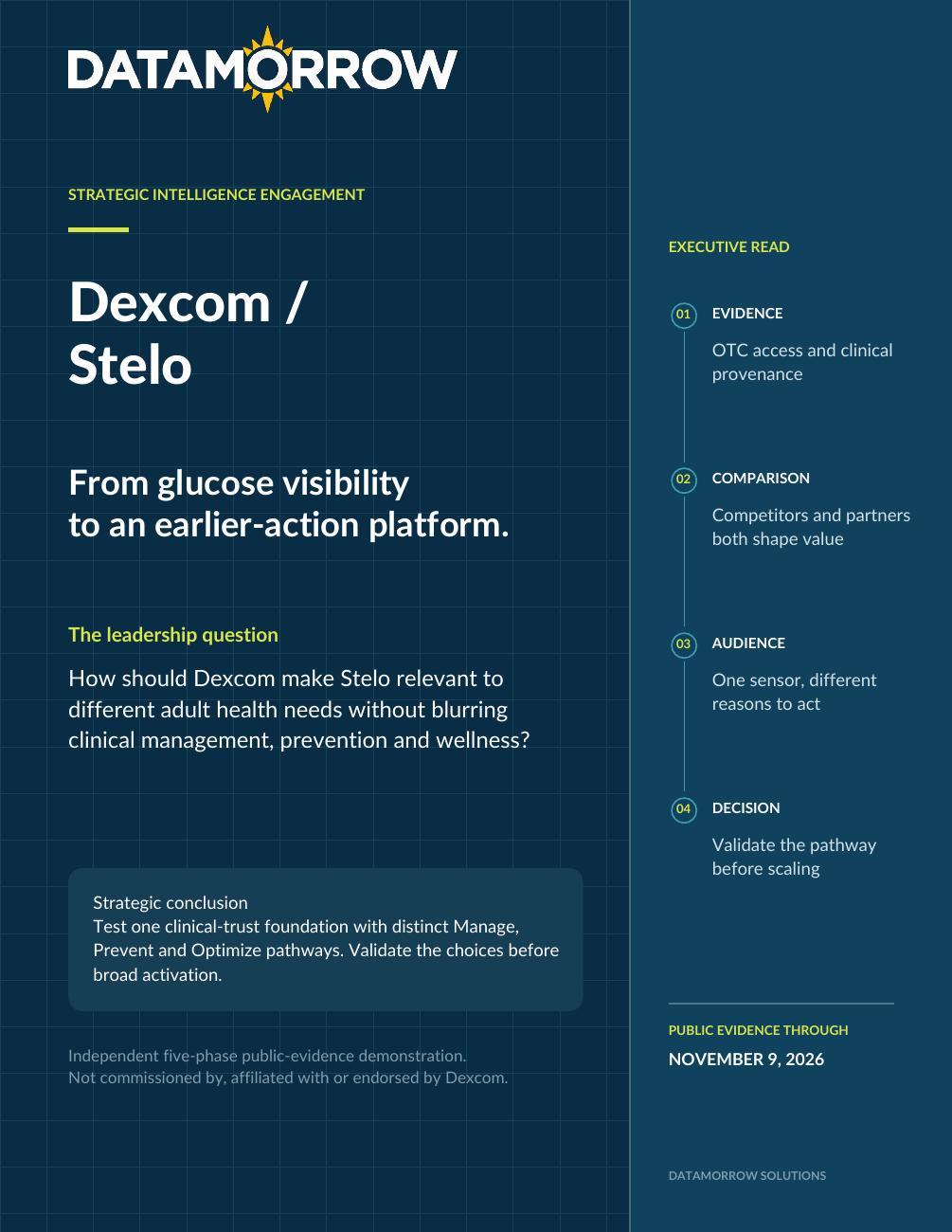
Dexcom / Stelo — From glucose visibility to an earlier-action platform — original report cover

Strategic Intelligence Engagement · Independent illustration · 9 pages

Dexcom / Stelo — From glucose visibility to an earlier-action platform

A five-phase public-evidence demonstration connecting competitive intelligence, audience priorities, an upgrade blueprint and executive synthesis.